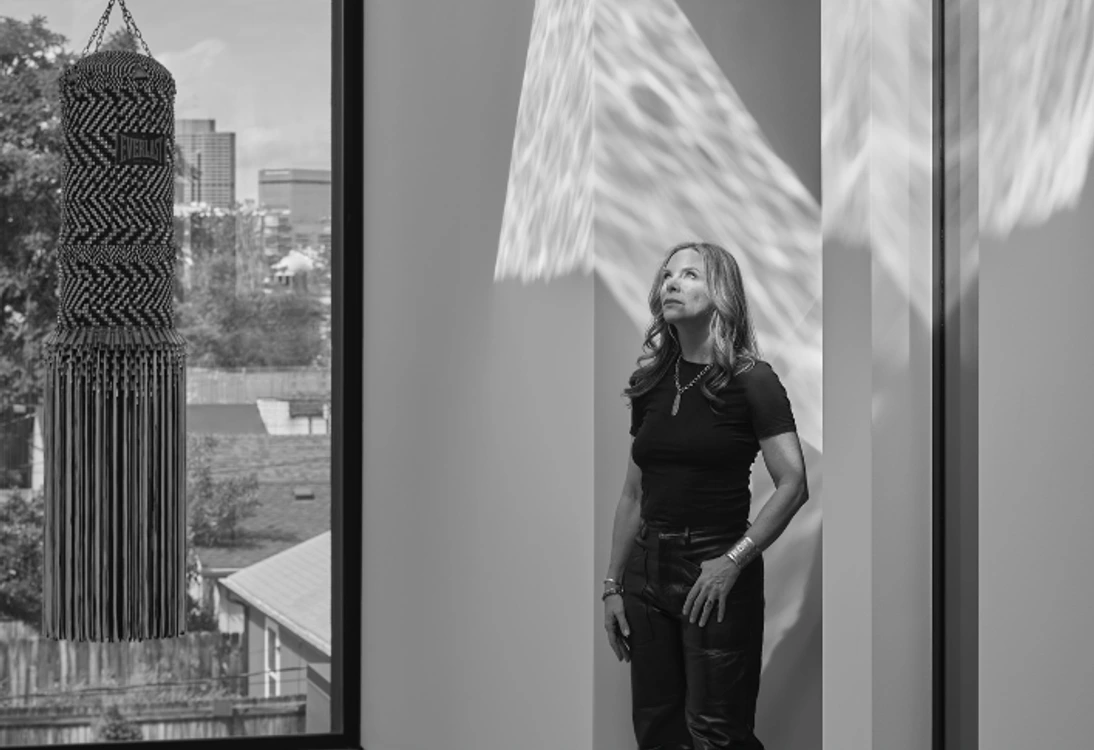
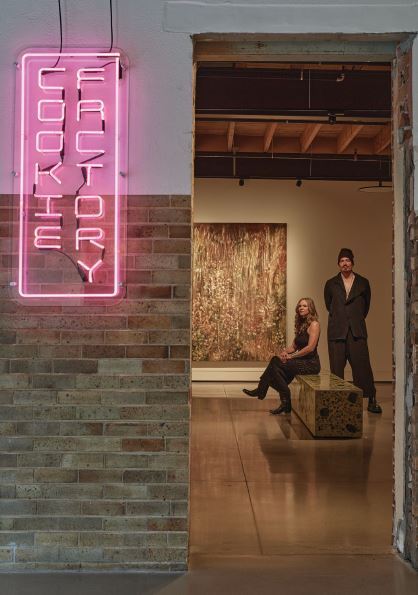
Amanda Precourt, shown here with her partner and Cookie Factory’s director of exhibitions, Andrew Jensdotter, transformed a 1940s fortune cookie factory into a vibrant public space for art.
PHOTO BY YOSHIHIRO MAKINO
“Growing up, I excelled in the arts, but more than anything, it was my way to moderate a chaotic world and childhood.” —AMANDA PRECOURT
In May 2025, a former fortune cookie factory now filled with contemporary art opened to the public in Denver. Just 19 days later, a behavioral health care facility treating acute mental health crises opened in Vail. The connective thread between these two seemingly disparate undertakings is Amanda Precourt, a Denver- based philanthropist whose personal journey is a story of art, mental health and deep learning about how to help others.
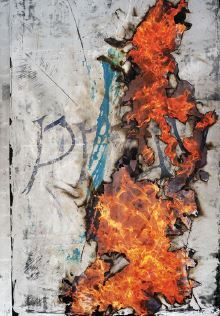
Korakrit Arunanondchai, “From Air to Fire” (2023, acrylic polymer on metallic foil on denim on inkjet print on canvas), 94 inches by 70 inches.
PHOTO COURTESY OF KORAKRIT ARUNANONDCHAI
“I really believe in art,” says Precourt, the visionary behind Denver’s Cookie Factory (cookiefactorydenver.com) and Vail’s Precourt Healing Center. “Growing up, I excelled in the arts, but more than anything, it was my way to moderate a chaotic world and childhood.” When she started having hints of depression and anxiety in her early teens, drawing and painting became an outlet to regulate emotions.
“From a young age, I was really involved in museums and the making of art,” Precourt says. In high school, she interned at the Denver Art Museum, where she was trained in art handling and cataloging. After college, she eventually moved back to Denver and started collecting art. She has been deeply involved with the Denver Art Museum since she first interned there in her teens, eventually serving as a trustee and chair of the collections. She’s also been a longtime supporter of the MCA. Around the time she joined the DAM board, she started looking at Denver’s cultural landscape and felt inspired to create something new.
“I was looking to fill a space that didn’t exist,” she says. She didn’t want to compete with Denver’s great art institutions, but rather to collaborate. “I thought, maybe we just feature one artist at a time, and they completely take over the space, and it’s privately funded, and it’s art that is done specifically for the space and for Denver— well, that’s totally new.” Her concept was for something between a museum, a gallery and a private collection— and it would be free to the public. The result is an institution that resists traditional definition. “We’re a new container for art. I don’t even know what to call it, but it’s a cultural gift to Denver,” she says.
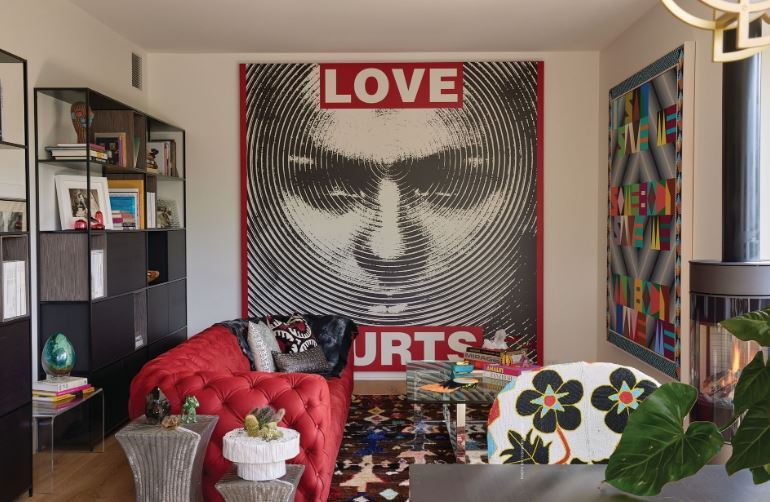
Barbara Kruger’s “Untitled
(Love Hurts)” (2012) is the
focal point of this space
inside the Cookie Factory.
At right, Jeffrey Gibson’s
“Save Me” (2018).
PHOTO BY YOSHIHIRO MAKINO
“We’re a new container for art. I don’t even know what to call it, but it’s a cultural gift to Denver.”—AMANDA PRECOURT
The Cookie Factory building, which is also Precourt’s art-filled home, was built in 1941 as a paper mill. In the 1950s, it was turned into a fortune cookie factory, which operated for more than six decades. “It’s like the building is interwoven with good fortune and this ethos of making cookies for the community and beyond,” she says. “I wanted to honor the space and not just demolish the building. And I wanted it to be community-based.”
It might seem like a 180 that the same person who opened this cutting-edge art space is also the person who spearheaded the only Level 1 inpatient psychiatric hospital between Denver and Salt Lake City, but the through-line is Precourt herself. “Precourt Healing Center was born of my own experience. I had a really challenging acute mental health issue,” Precourt says. “I ended up in the hospital with armed guards outside my door because I was a threat to myself. Most people either end up in the ER or the police station.” She survived, in part, she says, because she had access to resources that others don’t have. “When I got out of treatment, I just thought, ‘This is wrong.’”
Precourt is not alone in her struggles. Whether caused by isolation, party culture or economic pressure, the “paradise paradox” is real in Colorado. Ski and mountain towns have up to three times higher rates of depression, substance abuse and suicide than state averages. Before the Precourt Healing Center opened, very few psychiatrists were practicing in the Vail Valley, and none of them took insurance.
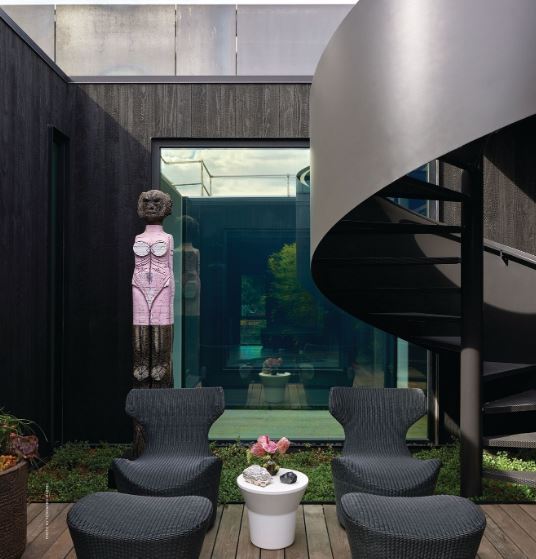
A deck on top of the Cookie Factory is yet another tranquil space filled with art.
PHOTO BY YOSHIHIRO MAKINO
Precourt witnessed the mental health crisis unfolding in Vail, and her own experience guided her vision for the Precourt Healing Center. “We’re where you go if you’re put on a 72-hour hold or if you have a drug- and alcohol-related incident,” she says. In addition to acute psychiatric care, the center offers continuation of care with the same doctors. The center has an inpatient psychiatric staff of 15 (across inpatient and outpatient) and some 30 therapists, as well as animal-assisted therapy, yoga, meditation and, of course, art therapy. “It’s looking at the person holistically—the whole ecosystem of behavioral health,” Precourt says. “And we’re seeing real, positive change.” Since the center opened, suicide rates are down by 67%, she says.
The center has been at capacity since opening, but Precourt hopes that in 10 years, the community will be healthier—and the center will be quiet. In the meantime, she will continue to cultivate spaces for expression and spaces for crisis. Together, these efforts reflect a single ambition: to give people tools to connect, survive and thrive. “I want to create a community through the Cookie Factory and the Precourt Healing Center where people can talk about struggles but also talk about inspiration—talk about art, talk about beauty and talk about things that are bigger than our emotional struggles for that day.”